
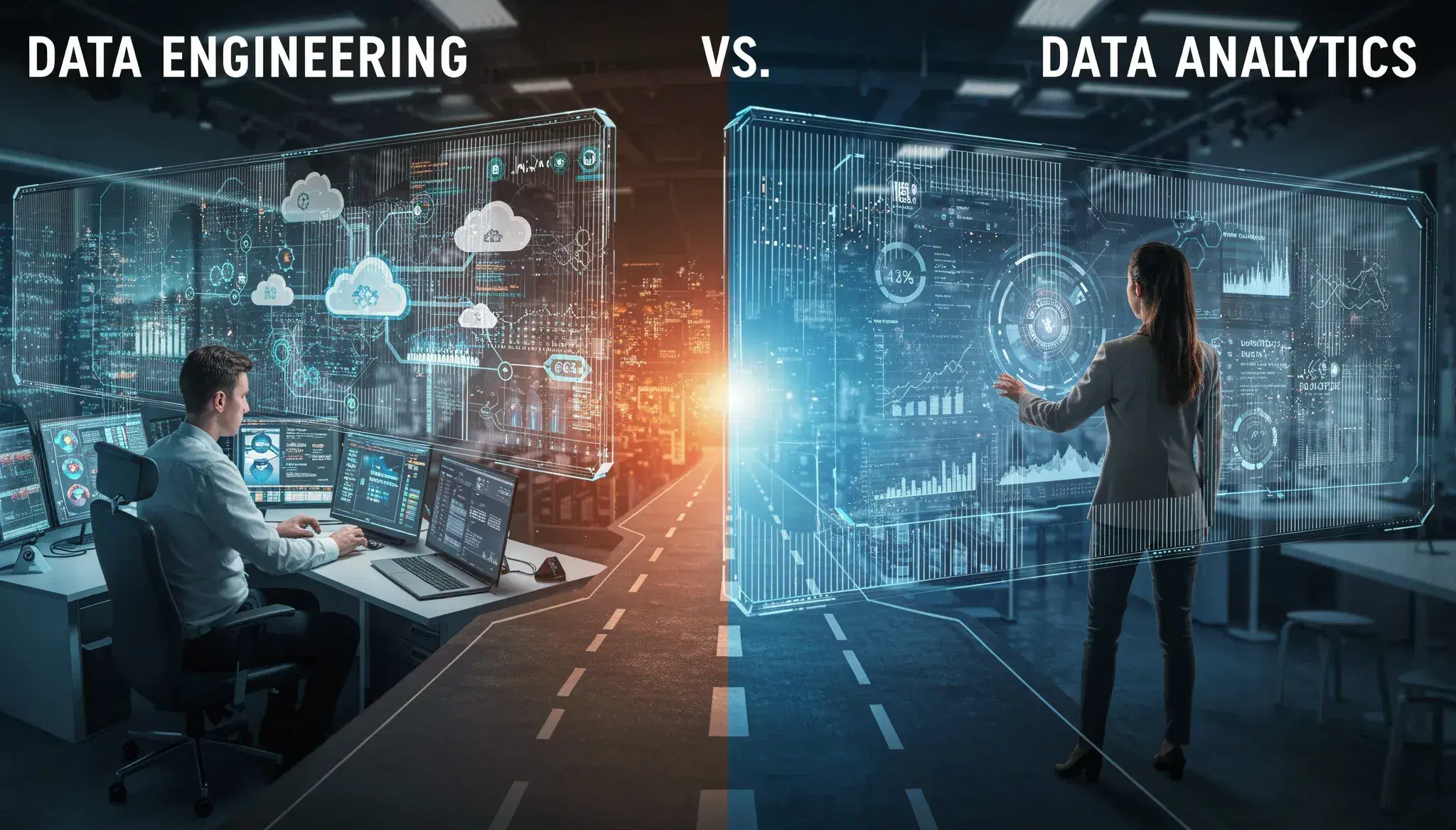
Riya, a final-year student, is ready to step into the data world. She loves working with numbers and watching dashboards. But when she searches for a career path, she gets overwhelmed.
She googles:
- "Data Analytics career"
- "Data Engineering jobs"
- "Data analysis courses for beginners in India"
Instead of clarity, she gets confused. Some say Data Analytics is the best. Others say Data Engineering is the "real" tech job.
Her question is probably your question too:
"Which one should I choose – Data Engineering or Data Analytics?"
This blog will help students like Riya who are stuck between these two paths. We’ll break things down in simple terms so you can make the right choice based on your interests, strengths, and career goals.
What Is Data Analytics?
Data Analytics focuses on interpreting data to answer key business questions. Imagine working for an e-commerce company. Your manager asks:
- "Why did sales drop last week?"
- "Which product is selling the most in Delhi?"
- "Are our discount campaigns working?"
As a Data Analyst, your job would be to answer these questions using data. You’d:
- Gather data from different sources (sales, marketing, etc.)
- Clean and organize the data
- Identify patterns and trends
- Create reports and dashboards
- Present findings to business teams
You’d work with tools like:
- Excel or Google Sheets
- SQL (for pulling data)
- Power BI or Tableau (for creating reports)
If you like finding patterns, making charts, and explaining data to people, Data Analytics might be for you.
What Is Data Engineering?
Data Engineering is about building the infrastructure and systems that make data useful. Before a Data Analyst can use data, it needs to be collected, stored, and cleaned properly. This is where Data Engineers come in.
As a Data Engineer, you would:
- Design and build data pipelines (systems that move data from one place to another)
- Ensure that data is safe, reliable, and easily accessible for Data Analysts and Data Scientists
- Manage databases and data storage systems
You would work with tools like:
- SQL and Python
- Cloud platforms like AWS, Azure, or Google Cloud
- Tools like Spark, Kafka, and Airflow
If you enjoy building systems and solving technical problems, Data Engineering might be a better fit for you.
Data Analytics vs. Data Engineering
Here’s a simple comparison to help you decide which path suits you:
| Aspect | Data Analytics | Data Engineering |
|---|---|---|
| Focus | Understanding and interpreting data | Building data systems and pipelines |
| Main Tools | Excel, SQL, Power BI, Tableau, Python | SQL, Python, Spark, Kafka, Cloud |
| Work With | Business teams, marketing, sales | Data analysts, data scientists |
| Questions Answered | "Why did this happen?" | "How do we get the data?" |
| Best For | Those who enjoy finding patterns and storytelling with data | Those who enjoy building systems and solving tech problems |
This table should help you understand what aligns best with your strengths and interests.
Skills for Data Analytics
If Data Analytics sounds like the right path, here’s what you need to get started:
- Excel: Learn to clean data, use formulas, and create basic charts.
- SQL: Understand how to pull data from databases (learn commands like SELECT, WHERE, JOIN).
- Data Visualization Tools: Learn to create dashboards in Power BI or Tableau.
- Basic Statistics: Know how to calculate averages, percentages, and trends.
- Communication: Be able to explain your findings clearly to non-technical people.
For students interested in data analysis courses for beginners in India, make sure the course covers:
- Real-world projects
- Hands-on practice with tools like Power BI or Tableau
- Dashboards you can add to your portfolio
Skills for Data Engineering
If you’re more inclined towards Data Engineering, you’ll need these skills:
- Strong SQL: Write queries to handle large datasets.
- Programming (Python): Automate data tasks and work with files.
- ETL (Extract, Transform, Load): Learn how to move data from one system to another.
- Cloud Basics: Understand how data is stored and processed on cloud platforms like AWS, Azure, or GCP.
- Data Warehousing: Know how to organize and store data efficiently.
If you choose a Data Engineer course, make sure it includes:
- Basic programming
- Data flow concepts
- Hands-on projects
Which Path Should You Choose?
Let’s go back to Riya.
She tried a few things:
- Built a sales dashboard in Excel and Power BI
- Set up a small ETL pipeline using Python
She felt:
- Excited when explaining her findings and presenting dashboards
- Drained when fixing errors in long scripts
That’s her clue: Data Analytics suits her more.
For you, ask yourself:
- Do you enjoy finding patterns in numbers and explaining them? → Data Analytics might be your path.
- Do you enjoy building the systems that handle the data? → Data Engineering could be a better fit.
A Quick Note on Training
Before you dive into any course, make sure it aligns with your career goal. A good course will:
- Start with your current skill level
- Focus on hands-on practice (not just theory)
- Help you build a portfolio of real-world projects
If you want to get a head start, Idea Institute offers Data Analytics and Data Engineering programs that focus on real skills, not just certificates.
Conclusion
Choosing between Data Engineering and Data Analytics doesn’t have to be difficult. Start by trying small projects to see what excites you more. Both fields have great potential, so pick the one that feels the most natural to you.
Not sure which career path to choose? Join Idea Institute for the right career path for your career goals.