

The demand for data professionals has increased rapidly over the past few years. While many people are familiar with data analysts and data scientists, fewer understand what does a data engineer do in a typical workday.
Behind every dashboard, business report, or machine learning model, there is usually a data engineer responsible for preparing the data that powers those insights.
In simple terms, data engineers design and maintain the systems that collect, organize, and deliver data so that analysts and business teams can use it effectively.
Understanding the data engineer roles and responsibilities can help students decide whether this career path matches their interests and skills.
What Does a Data Engineer Do in a Typical Day?
A data engineer’s daily work revolves around managing and transforming data so it becomes reliable and accessible for analytics.
Most organizations collect data from multiple sources such as websites, mobile apps, sales systems, and customer platforms. This raw data needs to be cleaned, structured, and stored properly before anyone can analyze it.
A typical day for a data engineer may include:
- Building and maintaining data pipelines that move data between systems
- Cleaning and transforming raw datasets
- Monitoring data systems for performance and errors
- Working with analysts and data scientists to provide the right datasets
- Optimizing databases for faster queries
Industry reports suggest that companies spend nearly 60 percent of their data team’s time preparing and organizing data, which highlights the importance of data engineering.
Core Data Engineer Roles and Responsibilities
To understand the data engineer roles and responsibilities, it helps to break them into key categories.
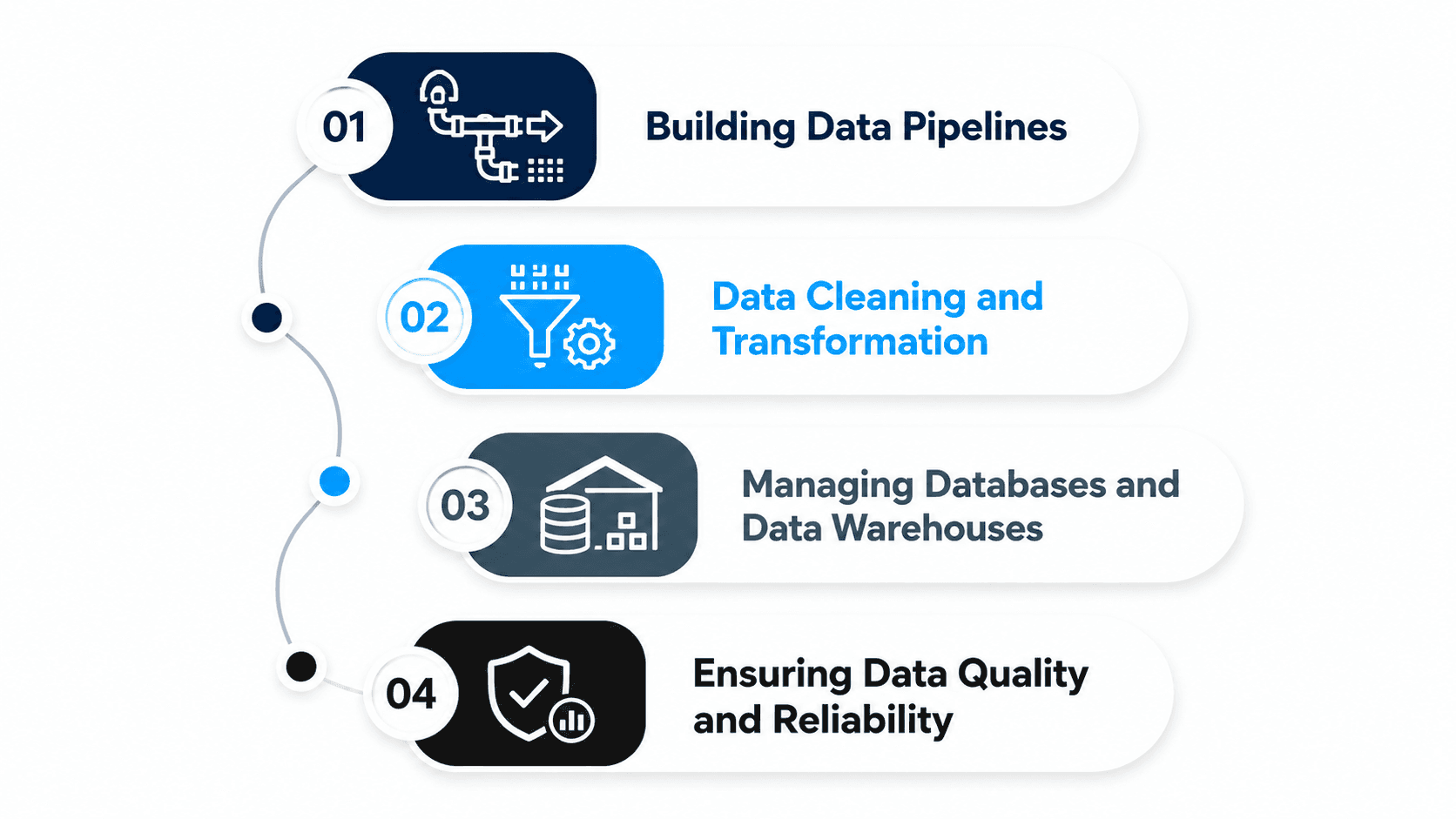
1. Building Data Pipelines
Data engineers create automated pipelines that move data from one system to another. These pipelines ensure that data flows smoothly from source systems into storage platforms or analytics tools.
For example, sales data from an e commerce platform might automatically move into a company’s data warehouse every few hours.
2. Data Cleaning and Transformation
Raw data is rarely perfect. It may contain missing values, duplicates, or inconsistent formats.
Data engineers design processes that clean and transform data so it becomes reliable for analysis.
Without proper data preparation, business teams may make decisions based on inaccurate information.
3. Managing Databases and Data Warehouses
Another key part of the data engineer job description is maintaining databases where large volumes of data are stored.
These systems must be optimized so analysts can retrieve information quickly.
Examples of commonly used platforms include cloud data warehouses such as Snowflake, BigQuery, and Amazon Redshift.
4. Ensuring Data Quality and Reliability
Data engineers also monitor data systems to ensure that pipelines are running correctly and that the data remains accurate.
If a pipeline fails or a dataset becomes corrupted, the data engineer investigates and resolves the issue before it affects business reports.
Reliable data infrastructure is essential for organizations that rely on real time insights.
Tools Commonly Used by Data Engineers
A typical data engineer job description includes experience with several technical tools and technologies.
Here is a simple overview of tools used in data engineering.
Tool Category | Examples | Purpose |
|---|---|---|
Programming languages | Python, Scala | Building data pipelines |
Database languages | SQL | Querying and managing data |
Workflow tools | Apache Airflow | Scheduling automated tasks |
Cloud platforms | AWS, Azure, Google Cloud | Scalable data storage and processing |
Big data tools | Spark, Hadoop | Handling large datasets |
Learning these tools allows data engineers to build scalable systems capable of processing millions of records efficiently.
Skills That Make a Good Data Engineer
While technical knowledge is important, successful data engineers also rely on several core skills.
Important skills in data engineering
- Strong SQL knowledge for working with databases
- Understanding of data pipelines and ETL processes
- Programming skills in Python or similar languages
- Knowledge of cloud data platforms
- Problem solving and system design thinking
Many companies today are building modern data platforms, which means skilled data engineers are increasingly valuable.
Industry hiring reports show that data engineering roles have grown by more than 40 percent in the past few years, making it one of the fastest growing careers in the data field.
Why Data Engineers Are Critical for Businesses
Companies rely heavily on accurate and timely data to guide decisions.
However, raw data from different sources often arrives in messy formats and scattered systems. Without proper infrastructure, analysts would spend most of their time preparing data instead of analyzing it.
Data engineers solve this problem by building reliable pipelines and platforms that deliver clean datasets to business teams.
This is why organizations investing in analytics and artificial intelligence often expand their data engineering teams first.
Conclusion
Understanding what does a data engineer do helps reveal how important this role has become in modern organizations.
Data engineers build the foundation that allows analysts, scientists, and business teams to access reliable data quickly.
Their responsibilities include building pipelines, managing databases, ensuring data quality, and maintaining scalable data infrastructure.
For students interested in technology, problem solving, and large scale systems, data engineering offers a highly rewarding career path with strong future demand.
Start building industry ready data skills with the practical Data Engineering and Analytics programs at IDEA Institute.