

Let me tell you what nobody told me when I started researching data analytics courses.
I spent two months Googling. I watched a YouTube video titled "Data Analytics Full Course FREE." I started three different Udemy courses and quit all of them within a week.
Why? Because I had no idea what is data analytics course.
Everyone kept saying "learn data analytics" like it was one simple thing. But when I'd ask "What will I actually do every day?" or "Will I get a job after this?" — I got vague answers or marketing speeches.
So I'm writing the blog I wish I'd found back then. No jargon. No sales pitch. Just honest answers about what you'll actually learn, how long it really takes, and whether it's worth your time and money.
What Is Data Analytics Course? (The Real Answer)
Here's what it's NOT:
- Not "learning computers"
- Not just Excel with extra steps
- Not a magical job guarantee certificate
Here's what it actually is:
This is a common question that enters your mind “What is data analytics course. If you got someone with the wrong explanation at the beginning, this is the place where you turn towards the wrong direction. So having a correct update on this concept is very important. A data analytics course teaches you to take messy, raw data and turn it into clear answers that help businesses make decisions.
A company has millions of rows of sales data. They need someone to answer: Which products sell best? Why did revenue drop 15%? Which customers might stop buying?
You become that person — not by guessing, but by analyzing data using SQL, Python, Excel, and Power BI.
That's what a data analytics course trains you to do. With real messy data. Every single day.
What You Actually Learn (Month by Month)
Once I got updated on what is data analytics course, I finally joined a proper program. Here's what shocked me: I wasn't watching videos. I was coding. From day one.
Month 1: Foundation
You start with Python from absolute scratch. Installing Python. Understanding syntax, variables, data types. Writing simple programs. SQL and Python for beginners starts here — SELECT queries, WHERE clauses, basic database operations.
Week 3-4: Conditional statements (if, elif, else). You're writing small programs that make decisions based on data.
This month feels slow. You'll think "when do we get to the cool stuff?" Trust the process. These basics separate students who get hired from those who get stuck.
Month 2-3: Real Data Work
Data structures — lists, dictionaries, sets. You define functions, work with arguments, learn lambda functions.
Then Pandas and NumPy — the Python libraries that actually handle data. You're cleaning messy datasets, handling missing values, filtering thousands of rows automatically.
You learn Matplotlib for visualization — turning numbers into charts that tell stories.
Reality check: This is when some students quit. It gets hard. You'll debug code for an hour and feel stupid. But the ones who push through start feeling like actual data analysts.
Month 4-5: Industry Skills
Power BI training begins. You're building professional dashboards. Business intelligence course concepts click — fact tables, dimension tables, star schema.
You work with APIs, CSV files, JSON data. Hands-on data projects using actual business scenarios:
- Sales dashboard for e-commerce
- Customer churn analysis
- Inventory optimization reports
This is where you stop feeling like a student and start feeling like a professional.
Month 6: Job Ready
Resume building. Mock interviews. GitHub portfolio. Data analytics placement support — learning to explain your projects, practicing SQL queries on whiteboards.
Most courses don't teach this. But it's the difference between finishing a course and actually getting hired. Now I am thankful that I know what data analytics course is and even I am the master of this course.
Data Analytics Course Duration: The Honest Timeline
Full-Time Intensive (5-6 hours daily):
- Duration: 6 months
- Schedule: Monday-Friday, office hours
- Outcome: Job-ready with portfolio
This works for career change to data analytics and serious students. You code 5-6 hours daily, ask doubts on the spot, work alongside other learners.
Part-Time/Weekend:
- Duration: 8-12 months
- Schedule: 2-3 hours per session
- Outcome: Slower, requires extreme discipline
Works if you're employed. But learning 6 hours weekly vs 30 hours weekly makes a massive difference.
Self-Paced Online:
- Duration: 3 months to never
- Reality: 90% never finish
- Why: No accountability, no live help
I tried this. Bought four courses. Finished zero. Most people need structure and deadlines to push through difficult parts.
Real answer: For data analytics course duration — expect 5-6 months intensive to be placement-ready for data analyst jobs for freshers.
How It Actually Helps Your Career (Real Story)
Rajesh's Journey: BPO to Data Analyst
- Background: Call center, 3 years, ₹18,000/month, no growth
- Joined: 6-month intensive program starting from scratch
- Learned: SQL, Python, Power BI through daily practice
- Built: 5 portfolio projects during training
- Placed: Junior Data Analyst, ₹5.2 LPA (₹43,000/month)
- Impact: Not just money. Respect. Challenging work. Growth path.
What made the difference?
- Daily 5-6 hour coding practice
- Real mentor access (not email support)
- Practical data analytics skills built through projects
- Placement support with resume and mock interviews
That's the formula. Not magic. Just focused effort with proper guidance.
What to Look For in Any Data Analytics Training Institute
Don't choose based on brochures or "100% placement" promises. Visit in person. Here's what actually matters:
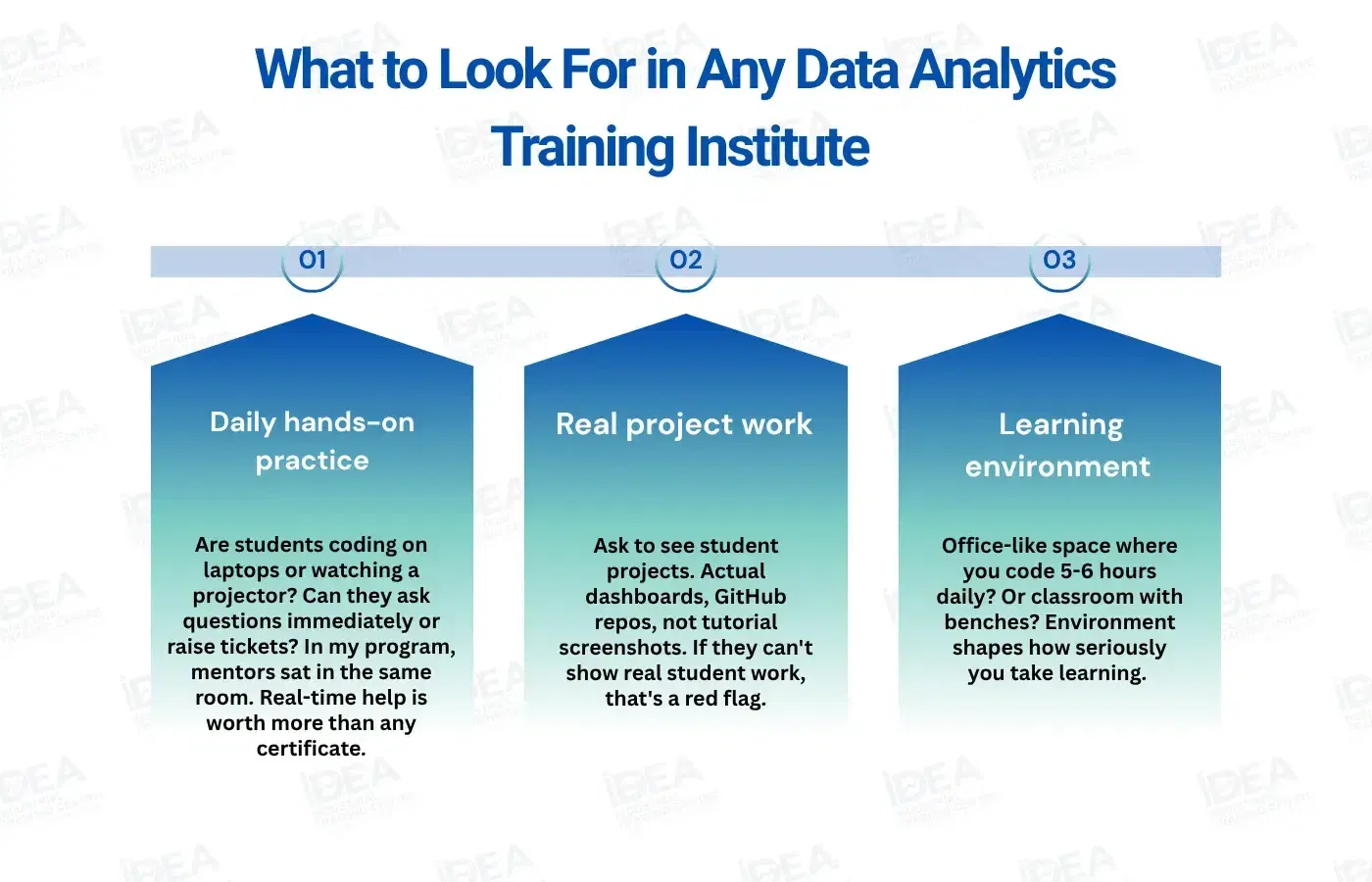
These criteria apply whether you're searching data analytics courses in Chandigarh or any city. Quality matters more than location.
The Investment Reality
Course fee: ₹40,000-₹1,20,000 (depending on institute)
Time: 5-6 months full-time
Returns:
- Fresher salary: ₹4-8 LPA (₹33,000-₹66,000/month)
- After 2 years: ₹8-12 LPA
- After 4 years: ₹12-18 LPA
If you take a ₹60,000 course and get placed at ₹5 LPA:
- First year salary: ₹5,00,000
- Course investment: ₹60,000
- ROI in first year: 733%
Even if placement takes 6 months post-course, you recover investment in first 2 months of salary.
What you can't measure in money:
- Respect at work (solving problems, not following orders)
- Clear growth path to senior roles
- Skill security (data skills needed everywhere)
- Remote work flexibility
Hard Truths Nobody Tells You
The first month feels slow. You'll think "why are we learning basics?" Week 6 onwards, you'll be glad you didn't skip steps.
You'll want to quit around Week 8-10. Loops, functions, Pandas get challenging. Everyone feels stupid here. The ones who push through get jobs. It's a filter, not a failure.
The certificate doesn't get you the job. What gets you hired:
- Can you write SQL queries without Googling?
- Can you clean messy datasets in Python?
- Can you explain your Power BI dashboard?
- Do you have a GitHub portfolio?
Data analytics certification gets your resume past HR. Skills get you the offer.
Your first job might not be "Data Scientist." Most freshers start as Junior Data Analyst, Business Analyst, or MIS Executive. That's okay. After 1-2 years, you move to specialized roles.
Are You Ready? (The Checklist)
You don't need:
- Engineering background (commerce, arts students do great)
- Previous coding knowledge (courses learn data analytics from scratch)
- Math genius skills (basic math is enough)
- Expensive laptop (4GB RAM works for learning)
You DO need:
- Basic computer skills (navigate folders, install software)
- Logical thinking (like solving puzzles)
- Commitment to 5-6 hours daily for 5-6 months
The pattern I've seen: The ones who got jobs weren't the smartest. They were the most consistent. They showed up daily, asked for help when stuck, built projects even when they didn't feel ready.
A data analytics course gives you tools, structure, mentorship, and environment. What you do with those 5-6 months determines everything.
Your Next Step
You've read enough blogs. You've compared enough courses. The real question — are you ready to start?
If you're serious about Excel to advanced analytics career change, visit an institute in person. Sit in a demo class. Watch students coding. Ask alumni about their experience. One visit tells you more than 100 blog posts.
Ready to stop researching and start learning? Explore IDEA Institute's 6-month Data Engineering & Analytics program. Visit Idea Institute or call to book your free demo class.