

The data career landscape is booming, but choosing between two of its hottest roles—data engineer and data scientist—can feel overwhelming. They sound similar, work with the same data, and often collaborate closely. Yet their day-to-day work, required skills, and career trajectories are fundamentally different.
If you've been stuck comparing data science vs data engineering, you're not alone. This guide breaks down each role with brutal honesty, compares what they actually do daily, and helps you figure out which path aligns with your natural strengths and career goals.
Understanding the Data Ecosystem First
Before diving into specifics, picture a restaurant kitchen. Data engineers are the infrastructure team ensuring ingredients arrive fresh, storage systems work flawlessly, and everything flows smoothly from supplier to prep station. Data scientists are the master chefs who take those perfectly organized ingredients and create innovative dishes, experimenting with flavors to delight customers.
Both roles are critical. Neither can function without the other. But they require different mindsets, skills, and personalities to excel.
Data Engineer:
What They Actually Do:
Data engineers design, build, and maintain the systems that collect, store, and move data across an organization. They create data pipelines that extract information from various sources (databases, APIs, files), transform it into usable formats, and load it into data warehouses where it's ready for analysis.
Daily Responsibilities:
- Building ETL/ELT pipelines that process millions or billions of records
- Managing cloud infrastructure on AWS, Azure, or Google Cloud Platform
- Optimizing database performance and query speeds
- Ensuring data quality, consistency, and reliability across systems
- Implementing data security, privacy, and governance protocols
- Troubleshooting pipeline failures and resolving system bottlenecks
- Scaling systems to handle growing data volumes
Key Technical Skills:
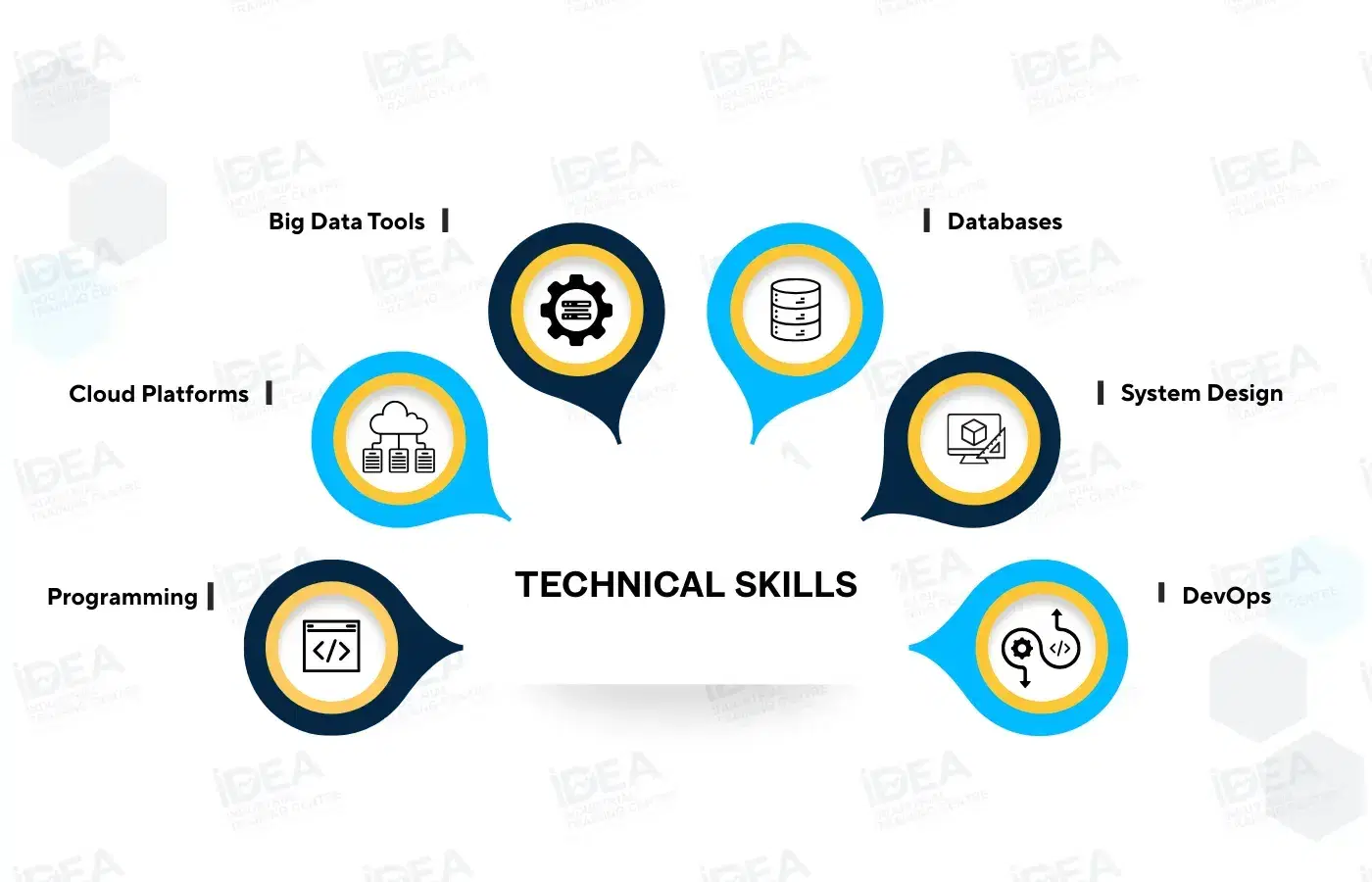
- Programming: Python (mandatory), SQL (daily language), Scala/Java (beneficial)
- Cloud Platforms: Snowflake, Databricks, AWS Redshift, Azure Synapse, GCP BigQuery
- Big Data Tools: Apache Spark, Kafka, Airflow, Apache Flink
- Databases: PostgreSQL, MySQL, MongoDB, Cassandra
- System Design: Understanding distributed systems, data modeling, architecture patterns
- DevOps: Docker, Kubernetes, CI/CD pipelines, Git
Who Thrives Here:
People who love building robust, scalable systems. You enjoy backend development and get genuine satisfaction from creating infrastructure that powers entire organizations. If debugging a complex distributed pipeline excites you more than building predictive models, data engineering is your calling.
You prefer solving well-defined technical challenges over open-ended business questions. You think in terms of systems, efficiency, and reliability.
Career Trajectory:
Junior Data Engineer → Data Engineer → Senior Data Engineer → Lead/Staff Data Engineer → Principal Engineer → Data Engineering Manager/Architect
Typical Salary Range (2026):
- India: ₹6-10 lakhs (entry-level), ₹12-18 lakhs (mid-level), ₹22-35 lakhs (senior)
- Global/US: $85,000-$120,000 (entry-level), $120,000-$160,000 (mid-level), $160,000-$220,000 (senior)
Data Scientist: The Insight Explorer
What They Actually Do:
Data scientists analyze complex datasets to extract insights, build predictive models, and solve business problems using statistical methods and machine learning. They answer critical business questions like "Why did customer churn increase?" "Which marketing campaigns will perform best?" or "How can we optimize pricing?"
Daily Responsibilities:
- Exploring datasets to identify patterns, trends, and anomalies
- Building machine learning models for prediction, classification, and recommendation
- Running A/B tests and designing statistical experiments
- Creating data visualizations and dashboards to communicate findings
- Developing algorithms for personalization, fraud detection, forecasting
- Collaborating with product and business teams to translate questions into analytical solutions
- Deploying models and monitoring their performance in production
Key Technical Skills:
- Programming: Python/R (essential), SQL (necessary for data access)
- Statistics & Math: Probability, hypothesis testing, regression analysis, linear algebra
- Machine Learning: scikit-learn, XGBoost, supervised/unsupervised learning algorithms
- Deep Learning: TensorFlow, PyTorch, neural networks (for advanced roles)
- Data Visualization: Matplotlib, Seaborn, Tableau, Plotly
- Business Skills: Translating business problems into data questions
- Communication: Presenting insights to non-technical stakeholders
Who Thrives Here:
Curious problem-solvers who enjoy experimentation, mathematics, and storytelling with data. You're fascinated by uncovering hidden patterns and building algorithms that predict future outcomes. You love asking "why" and "what if."
You're comfortable with ambiguity and open-ended problems. You think in terms of hypotheses, experiments, and insights that drive business decisions.
Career Trajectory:
Junior/Associate Data Scientist → Data Scientist → Senior Data Scientist → Lead/Staff Data Scientist → Principal Data Scientist → Head of Data Science
Typical Salary Range (2026):
- India: ₹7-12 lakhs (entry-level), ₹15-22 lakhs (mid-level), ₹25-40 lakhs (senior)
- Global/US: $90,000-$130,000 (entry-level), $130,000-$170,000 (mid-level), $170,000-$250,000 (senior)
Data Science vs Data Engineering:
Let's get brutally specific about the core differences in this data science vs data engineering debate:
Primary Focus:
- Data Engineers: Build the "how"—the infrastructure and systems that make data accessible
- Data Scientists: Explore the "why" and "what if"—generating insights and predictions from data
Daily Tools:
- Engineers: Airflow, Kafka, Spark, dbt, Docker, Kubernetes, cloud platforms
- Scientists: Jupyter notebooks, pandas, scikit-learn, TensorFlow, Tableau, statistical packages
Core Deliverables:
- Engineers: Reliable data pipelines, optimized databases, scalable infrastructure, data quality systems
- Scientists: Predictive models, business insights, recommendations, experimental results
Mathematical Requirements:
- Engineers: Logic, algorithms, system design thinking; less advanced math needed
- Scientists: Strong statistics, probability, linear algebra (especially for deep learning data engineering applications)
Coding Style:
- Engineers: Production-grade code built for scale, reliability, and maintainability
- Scientists: Exploratory code for analysis that may become production-ready with engineering support
Problem Types:
- Engineers: Well-defined technical challenges with clear success criteria
- Scientists: Ambiguous business problems requiring experimentation and iteration
Collaboration:
- Engineers: Work closely with software engineers, DevOps, platform teams
- Scientists: Work closely with product managers, business analysts, domain experts
Impact Measurement:
- Engineers: System uptime, pipeline reliability, data processing speed, cost efficiency
- Scientists: Model accuracy, business metric improvements, insight adoption, revenue impact
Job Market Reality in 2026
Demand Analysis:
Current market data shows higher demand for data engineers than data scientists. Why? Every organization needs solid data infrastructure before they can do meaningful data science. You can't build machine learning models without clean, accessible data—and that's what engineers provide.
Competition Levels:
- Data Engineering: High demand, moderate competition. Many companies struggle to find qualified engineers.
- Data Science: High demand, very high competition. It's the "sexier" role that attracts more applicants.
Entry Barriers:
- Data Engineering: Clearer skill requirements, more structured learning paths
- Data Science: Requires broader skillset including business acumen and advanced statistics
Remote Work:
Both roles are highly remote-friendly, with many companies offering hybrid or fully remote positions.
Which Path Should You Actually Choose?
Choose Data Engineering If You:
- Enjoy building systems and solving infrastructure challenges
- Prefer backend development over statistical modeling
- Like working with databases, cloud platforms, and distributed systems
- Value stability, process, and clearly defined problems
- Want high demand with less competition than data science
- Get satisfaction from creating tools others depend on
- Think in terms of "how can I make this faster/more reliable?"
Choose Data Science If You:
- Love statistics, mathematics, and machine learning
- Enjoy experimentation and hypothesis testing
- Want to directly influence business strategy with insights
- Are fascinated by AI, prediction, and pattern recognition
- Don't mind a more competitive job market
- Enjoy storytelling and communicating findings to stakeholders
- Think in terms of "what patterns exist?" and "what will happen next?"
Still Unsure? Consider These Questions:
- When debugging: Do you enjoy fixing the broken system or analyzing why it broke?
- In group projects: Do you build the infrastructure or extract the insights?
- Reading tech news: Are you drawn to system architecture articles or ML breakthroughs?
- Learning preference: Do you prefer defined technical courses or open-ended explorations?
Getting Started: Training and Learning Paths
Regardless of which path you choose in the data science vs data engineering decision, structured learning dramatically accelerates your journey. Self-teaching works but takes longer and lacks crucial industry context.
For Aspiring Data Engineers:
Data engineering training programs offer hands-on experience with modern tools like Snowflake, Databricks, Kafka, and cloud platforms—exactly what employers seek. Look for programs that include:
- Real-world pipeline building projects
- Cloud platform exposure (AWS/Azure/GCP)
- Modern data stack tools (Airflow, dbt, Spark)
- Data quality and testing practices
- Portfolio development support
If you're in North India, a data engineering course in Chandigarh can provide localized placement support, industry connections, and mentorship from working professionals.
For Aspiring Data Scientists:
Look for programs covering:
- Statistics and probability fundamentals
- Machine learning algorithms and frameworks
- Model deployment (increasingly important)
- Deep learning data engineering—the critical intersection of deploying ML models at scale
- Business communication and stakeholder management
- Portfolio projects with real business impact
Pro Tip for Both Paths:
Build projects that demonstrate actual problem-solving skills. Employers want to see:
- Your GitHub with documented work
- Real-world projects, not just tutorial follow-alongs
- Understanding of production considerations (for engineers: scalability; for scientists: model monitoring)
Can You Switch Between Them Later?
Absolutely. Many professionals successfully transition between data science vs data engineering because both roles share foundational skills:
Shared Foundation:
- Python programming
- SQL proficiency
- Understanding of data structures and databases
- Cloud platform familiarity
- Problem-solving mindset
Engineer → Scientist Transition:
You'll need to build expertise in statistics, machine learning, and business analytics. Your engineering background gives you a massive advantage—you understand how data systems work and can build production-grade ML pipelines.
Scientist → Engineer Transition:
You'll need to deepen your software engineering skills, learn distributed systems, and master data pipeline tools. Your analytical thinking helps you design better data architectures.
The Bottom Line
Here's the honest truth: there's no "best" role in the data science vs data engineering comparison—only the best fit for you.
If you're analytical but love building systems more than analyzing patterns, data engineering is your answer. You'll create the foundation that powers every data-driven decision in an organization.
If you're mathematically inclined and fascinated by prediction, experimentation, and business impact, pursue data science. You'll turn data into insights that directly shape company strategy.
The skills you build in either path create a solid foundation for the entire data career ecosystem. Start with the role that energizes you, build expertise, and remember—your career can evolve. Many of the best data professionals have experience in both domains.
Ready to start your data engineering journey? Click here for industry-aligned training in Chandigarh with placement support, hands-on projects, and mentorship from working data engineers.