
Let me guess — you've been Googling "best data analytics courses" for the past three days, opened 27 tabs, and you're more confused than when you started.
You're not alone. Every year, thousands of students and career seekers fall into the same trap. They see flashy ads, sign up for random data analytics courses online, watch a few pre-recorded videos, collect a PDF certificate, and then wonder why no company calls them back.
Here's the uncomfortable truth your parents need to hear too — a certificate alone won't get you a job in 2026. What gets you hired is the ability to actually work with data, solve real problems, and walk into an interview knowing you've already done what most candidates only read about.
This blog is your honest, no-sugar-coating guide to choosing the right data analytics course this year.
Why Data Analytics Is Still One of the Smartest Career Moves in 2026
Data analytics isn't a "trend" anymore. It's the backbone of how businesses operate — from healthcare and banking to e-commerce and logistics.
The numbers speak for themselves. India is expected to need millions of data professionals in the coming years, and the supply is nowhere close. Companies across Bangalore, Hyderabad, Pune, Delhi NCR, and even Tier-2 cities are actively hiring freshers who can work with SQL, Python, Excel, Power BI, and Tableau. The average data analyst salary for freshers in India today ranges from ₹4 to ₹8 LPA, and with 2–3 years of experience, that number climbs to ₹10–15 LPA quickly.
The opportunity is massive. But only if you learn the right way.
What Most Data Analytics Courses Get Wrong
Here's where students (and their parents) lose money and time. Most data analytics courses — whether online or offline — follow the same broken formula: pre-recorded videos, zero interaction with mentors, a multiple-choice test at the end, and a certificate that means almost nothing to recruiters.
Think about it from a hiring manager's perspective. Two candidates walk in. One has a certificate from a video-based course. The other has built live dashboards in Power BI, written Python scripts using Pandas and NumPy, cleaned messy datasets, worked with SQL databases daily, and can explain what an ETL pipeline does — because they actually built one.
Who gets the job? You already know the answer.
The best data analytics courses in 2026 are the ones that treat you like a working professional from day one — not like a student watching YouTube tutorials.
How to Pick the Right Data Analytics Course (A Simple Checklist)
Before you enroll anywhere, ask these five questions. If any answer is "no," keep looking.
- Is it a practical data analytics program or just theory? The course should focus on hands-on coding and real-world projects — not just PowerPoint slides. You should be writing Python syntax, building SQL queries, and creating dashboards from week one.
- Do you get real mentor access? Look for programs where you can ask doubts on the spot — not raise a ticket and wait 48 hours. Learning data analytics with live, on-the-spot doubt clearance makes a massive difference in how fast you grow.
- What tools and technologies are covered? A solid data analytics course in 2026 should cover Python (including libraries like Pandas, NumPy, and Matplotlib), SQL, Excel, Power BI or Tableau, and at least an introduction to cloud platforms like AWS or Azure. Bonus points if they teach you about data handling with CSV, JSON, APIs, and Flask basics for web development.
- How many hours per day do you actually learn? Weekend classes and 1-hour sessions don't build careers. Look for intensive programs — ideally 5–6 hours of daily data analytics training — where you sit in a real office environment and code alongside professionals. That kind of immersion is what separates data analytics courses near me search from an actual career launchpad.
- Is there placement support? Not a vague "we'll help you" promise, but real support — resume building, LinkedIn profile optimization, mock interviews, and job referrals.
What Your 2026 Data Analytics Learning Path Should Actually Look Like
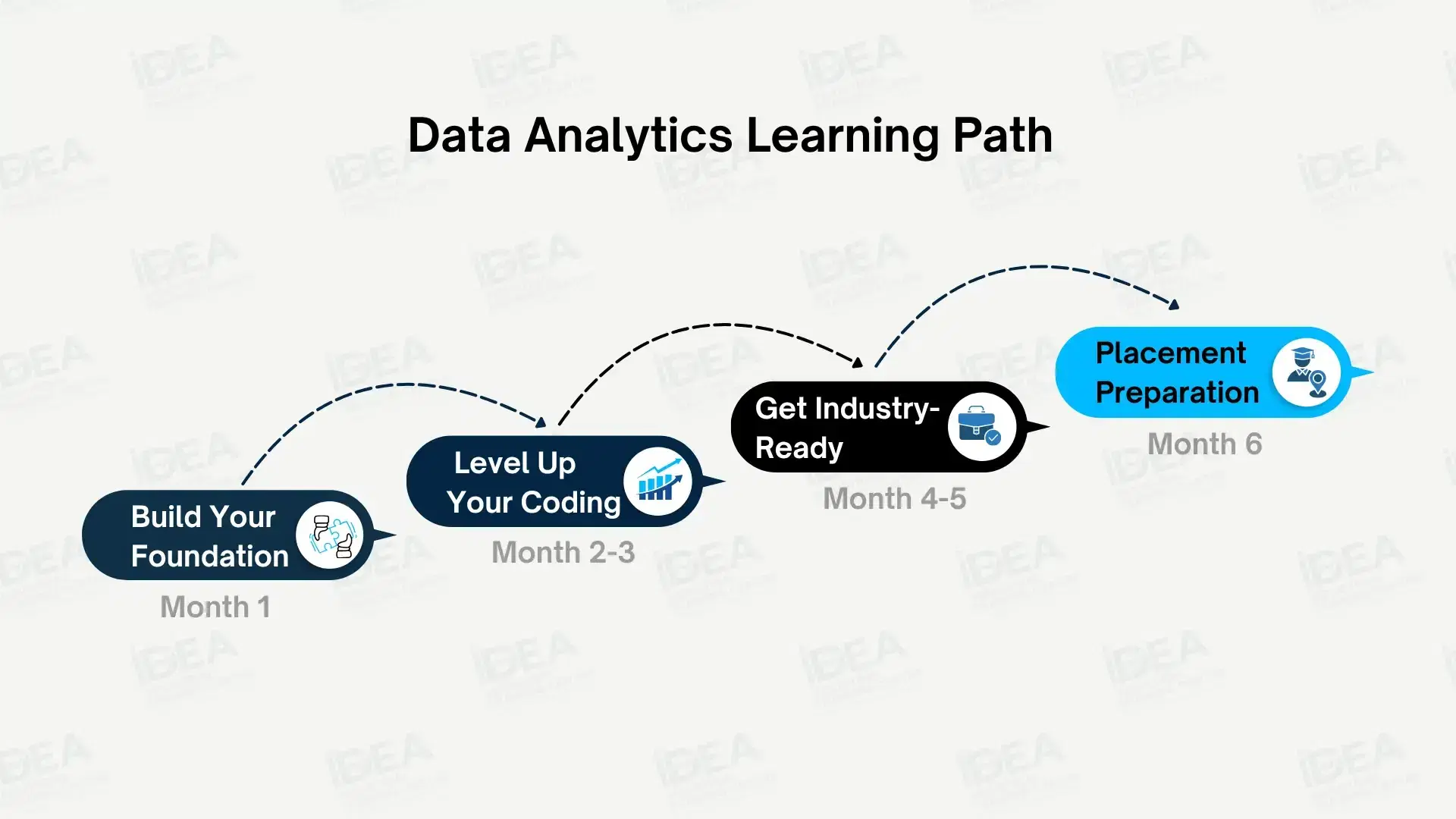
If you're starting from zero, here's a realistic progression that works:
Month 1 — Build Your Foundation: Start with basic Python — installing Python, understanding syntax and indentation, working with variables and data types, learning input/output operations, and writing conditional statements using if, elif, and else. Simultaneously, learn SQL fundamentals — this is non-negotiable for any data role.
Month 2–3 — Level Up Your Coding: Move into data structures like lists, tuples, dictionaries, and sets. Learn to define functions, work with arguments, and understand lambda functions. Start using control flow concepts — loops, comprehensions, and loop controls like break, continue, and pass. This is also when you should begin working with Pandas and NumPy for real data manipulation and Matplotlib for visualization.
Month 4–5 — Get Industry-Ready: Build Power BI dashboards using actual business data. Learn data warehousing concepts. Work with APIs and understand how to read and write CSV and JSON files. Get comfortable with object-oriented programming — classes, constructors, inheritance, and encapsulation. Start handling files, exceptions, and learn about iterators, generators, and decorators.
Month 6 — Placement Preparation: Polish your resume. Practice mock interviews. Build a GitHub portfolio. Get referrals and start applying.
This isn't a random sequence — this is exactly how professionals learn on the job. And the best data analytics courses follow this exact kind of structured, practical path.
A Word for Parents Reading This
You want your child to get a good job. That's all any parent wants. But here's what has changed — a degree alone doesn't guarantee that anymore. What matters now is skill, portfolio, and practical experience.
When you're evaluating data analytics courses for your son or daughter and scrolling for the best data analytics course near me, don't just look at the fee. Look at what they'll actually be doing every day. Are they sitting in an office environment or a tuition center? Are they coding 6 hours daily with professionals, or watching recordings on a laptop at home? Are mentors available on the spot, or is your child waiting for a response?
The right training program treats your child like a future employee — not like a customer.
The Certification That Actually Matters
Here's a secret most course providers won't tell you — the data analytics certification itself is the least important part. What matters is what you can demonstrate during an interview. Can you write a SQL query on a whiteboard? Can you clean a dataset in Python without Googling every step? Can you explain your Power BI dashboard and the business decisions it supports?
That said, an ISO-certified program from a reputed institute does add credibility to your resume. It tells employers that the training you received followed industry standards. Just make sure the data analytics certification is backed by real skills, not just a completion checkbox.
Your Next Step Isn't Another Google Search
You've read enough blogs. You've compared enough courses. The real question is — are you ready to actually start?
The best time to learn data analytics was last year. The second-best time is today.
Explore IDEA Institute's 6-month Data Engineering & Analytics program — where students code daily, learn from industry experts, and walk out job-ready. Visit Website.