

Aarav’s Confusing Start
Aarav was in his final year of college when he decided:
“I want to work in data.”
He liked numbers, he enjoyed solving small logical puzzles, and he kept hearing that data analytics and data engineering were “the future.”
One night, he opened his laptop, searched:
“best data course”
“course data analytics”
“data analyst course with job guarantee”
Within seconds, his screen was filled with:
- “3-month data analyst course – 100% placement*”
- “6-month data engineer course – earn 10 LPA”
- “Become a data expert in 30 days”
It looked exciting.
It also felt… overwhelming.
“Which one is real?”
“What if I choose the wrong one?”
“What if I waste my parents’ money?”
Aarav did what many students do: he picked a data course quickly, based mostly on ads and promises.
Months later, after finishing that course, he realised he had made several mistakes—mistakes that cost him time, money, and confidence.
This blog is Aarav’s story, and the 10 mistakes he made while choosing a data course—so that you don’t have to repeat them.
1. Following the Trend, Not His Interest
The first course Aarav chose was simple:
- It was viral on social media.
- Many of his friends had joined.
- The ad said “Data is the new oil.”
He did not ask himself:
- “Do I enjoy this kind of work?”
- “Do I want to analyse business reports or build systems?”
After a few weeks, he realised the course was heavily focused on data science theory, while he actually enjoyed working with dashboards and simple business questions more.
Lesson for You
Don’t choose a data course only because it is trending.
Ask yourself:
- Do you enjoy analysing and explaining numbers? → A data analyst course may suit you.
- Do you enjoy building systems, pipelines, and working behind the scenes? → A data engineer course may be better.
Your interest is more important than the trend.
2. Chasing the Certificate, Forgetting the Skills
Aarav’s first thought was:
“I just need a certificate. Recruiters will notice me.”
His course gave a fancy-looking certificate.
But when he attended his first interview and was asked:
- “Can you write a simple SQL query?”
- “Can you explain a project you did?”
He froze.
He had watched the lectures.
He had notes.
But he had no strong skills and no clear projects.
Lesson for You
Companies don’t hire certificates.
They hire skills and proof of work.
Before joining any data course, ask:
- Will I build 2–3 real projects?
- Will I practice SQL, Excel, Power BI, Python, not just watch videos?
Think beyond the certificate. Think about what you can show and explain in an interview.
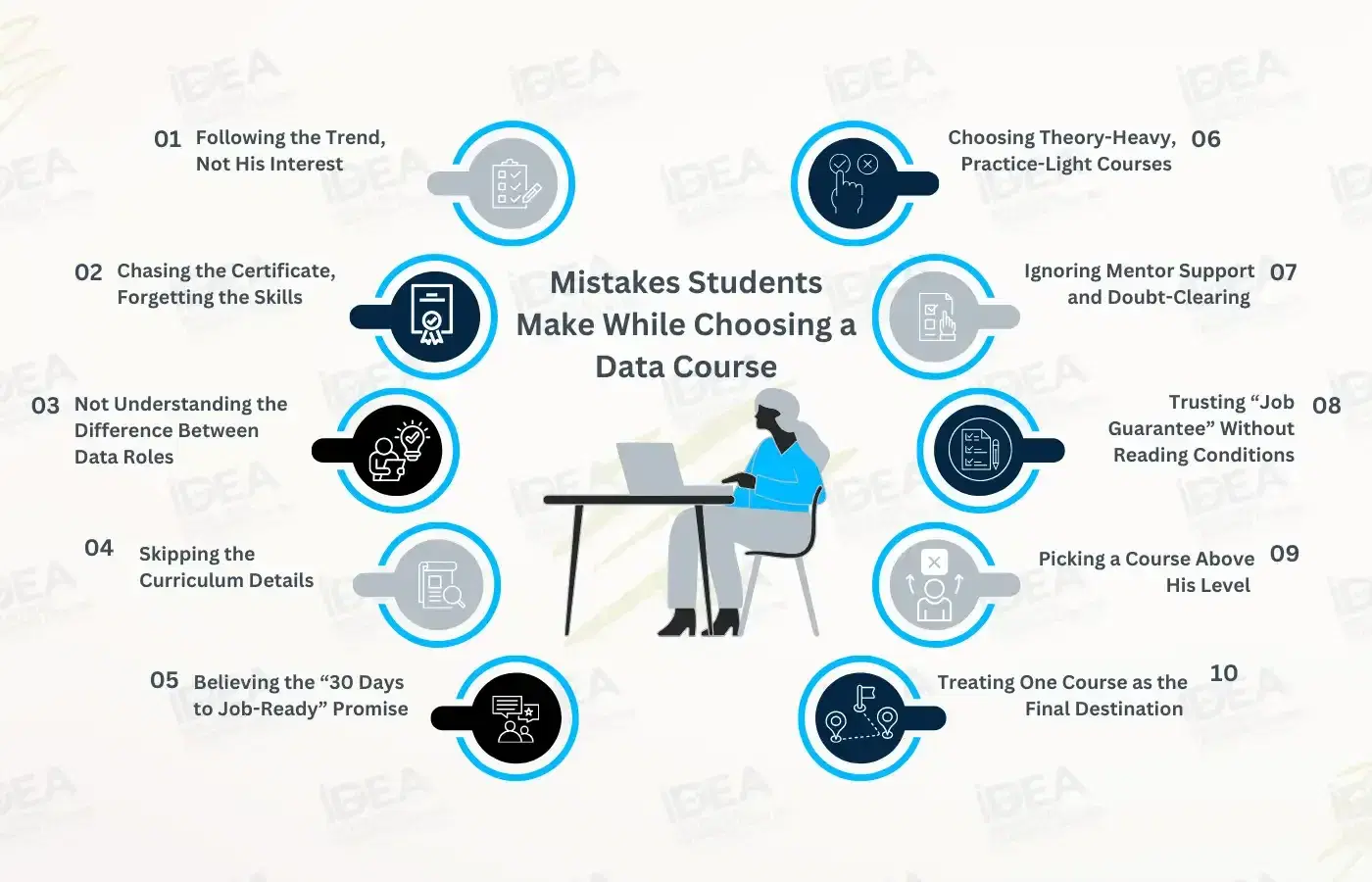
3. Not Understanding the Difference Between Data Roles
At the beginning, all words sounded the same to Aarav:
- Data Analyst
- Data Engineer
- Data Scientist
So when he saw a course bundle that included all three titles, he thought:
“Great, I will become all three.”
But the course touched everything at a very surface level.
He was never clear:
- What does a data analyst really do every day?
- What does a data engineer actually build?
He could not explain his career goal clearly in interviews.
Lesson for You
Spend some time understanding roles:
- Data Analyst – works with reports, dashboards, KPIs, and business questions.
- Data Engineer – builds and maintains data pipelines, databases, and data systems.
Knowing the difference will help you choose a data analyst course or data engineer course that matches your direction.
4. Skipping the Curriculum Details
When Aarav joined his first course, he only checked:
- Duration
- Fees
- Job guarantee claim
He did not carefully read the curriculum.
Later, he found:
- There was very little SQL
- Almost no hands-on work in Power BI or Tableau
- No focus on real industry-style projects
It sounded good in marketing, but was weak in content.
Lesson for You
Always read the detailed syllabus of any data course:
Check if it includes:
- For data analytics:
- SQL
- Excel / Power BI / Tableau
- Real project work
- For data engineering:
- SQL
- ETL and pipelines
- Cloud basics
- At least one end-to-end project
If the curriculum is too vague (“Intro to data” everywhere), be careful.
5. Believing the “30 Days to Job-Ready” Promise
One of the ads Aarav saw said:
“Become job-ready in 30 days – no experience needed.”
That line pulled him in.
But after 30 days, he had:
- Watched fast, dense videos
- Tried to remember many buzzwords
- Built no strong project
He felt more stressed, not more confident.
Lesson for You
Learning data analytics or data engineering is not a race.
It needs:
- Time
- Practice
- Repetition
A good course data analytics program should give you space to:
- Practice hands-on
- Repeat concepts
- Work on assignments and projects
Be careful of “too fast to be real” promises.
6. Choosing Theory-Heavy, Practice-Light Courses
In Aarav’s first course:
- Most sessions were slides
- The instructor talked about tools
- But there was very little live demo and almost no guided practice
When he tried to build something on his own, he did not know where to start.
Lesson for You
Data is a practical field.
Ask before joining:
- How much of the course is hands-on?
- Will I get access to datasets to practice?
- Will I build dashboards, reports, or pipelines myself?
Good courses make you do the work, not only listen to it.
7. Ignoring Mentor Support and Doubt-Clearing
Whenever Aarav got stuck, he had to:
- Raise a ticket
- Wait for an email
- Or search YouTube on his own
There was no real-time support, no one to review his project, and no one to tell him:
“You are improving. Here is what to fix.”
Slowly, his motivation dropped.
Lesson for You
Learning alone is harder.
Look for a data course that offers:
- Live doubt-clearing sessions or Q&A
- Project review and feedback
- Mentors who actually respond and guide you
Sometimes, good guidance is more valuable than extra content.
8. Trusting “Job Guarantee” Without Reading Conditions
The “100% job guarantee” line was one big reason Aarav joined.
Later he discovered:
- The guarantee was valid only if:
- He scored above a certain percentage in internal tests
- He attended every single class
- He applied only through their portal
In the end, they only shared some interview links. There was no real guarantee.
Lesson for You
“Job guarantee” often has many conditions.
Before believing such a promise, always ask:
- Can I see the written policy?
- What does “job guarantee” actually mean?
- What happens if I don’t get placed?
Focus on:
- Strong skills
- A good portfolio
- Interview preparation
These matter more than bold headline promises.
9. Picking a Course Above His Level
At one point, Aarav panicked:
“I’m behind. I must learn AI, ML, and deep learning now.”
He enrolled in an advanced program that included:
- Complex statistics
- Machine learning algorithms
- Big data tools
But his basics in:
- Excel
- SQL
- Simple Python
were still weak.
He felt lost and started believing:
“Maybe data is not for me.”
The problem was not him. The problem was the wrong level of course.
Lesson for You
Be honest about your current level.
If you are a beginner, start with:
- Excel
- Basic SQL
- Basic Python
- Simple dashboards
Once you are comfortable, you can move to more advanced data analyst course or data engineer course options.
10. Treating One Course as the Final Destination
When Aarav joined his first program, he thought:
“After this, I will know everything.”
But after finishing, he realised:
- Tools change
- New methods appear
- There is always more to learn
At first, this scared him. Then he realised something important:
A data course is not the final answer. It is the starting point.
Lesson for You
Think of your learning in phases, not as a one-time event:
- Phase 1: Basics – Excel, SQL, Python, simple dashboards
- Phase 2: Projects – end-to-end case studies
- Phase 3: Advanced – cloud, big data, or ML, depending on your path
A good course should help you build a base and show you what to do next.
Conclusion: Learn from Aarav, Don’t Repeat His Mistakes
Looking back, Aarav realised he had made many common mistakes:
- He followed trends, not his interest.
- He chased certificates instead of skills.
- He didn’t understand the difference between data roles.
- He skipped reading the detailed curriculum.
- He believed in “30 days to job-ready” marketing.
- He chose theory-heavy, practice-light training.
- He ignored the importance of mentor support.
- He trusted job guarantees without reading the fine print.
- He picked courses above his real level.
- He treated one course as the final answer, not a starting point.
The result:
He lost time and confidence before finally finding the right path.
You don’t need to go through the same journey.
If you:
- Ask the right questions
- Understand your interests
- Check the structure of any data course carefully
- Focus on skills and projects
…you can choose a data analyst course or data engineer course that actually moves you closer to your first job in data.
Ready to avoid these mistakes and choose the right data course for your future? Click here to begin with the best path for you in data analytics or data engineering.